From Swifties to Sunday roasts: the ramshackle pleasure boat that became a symbol of survival
In a corner of Britain scarred by post-industrial decline, the Teesside Princess has become an unlikely font of communal defiance. What do grand promises of local regeneration look like from the water?
-Published in the Observer
-October 2025
-Original photography by Rob Stothard
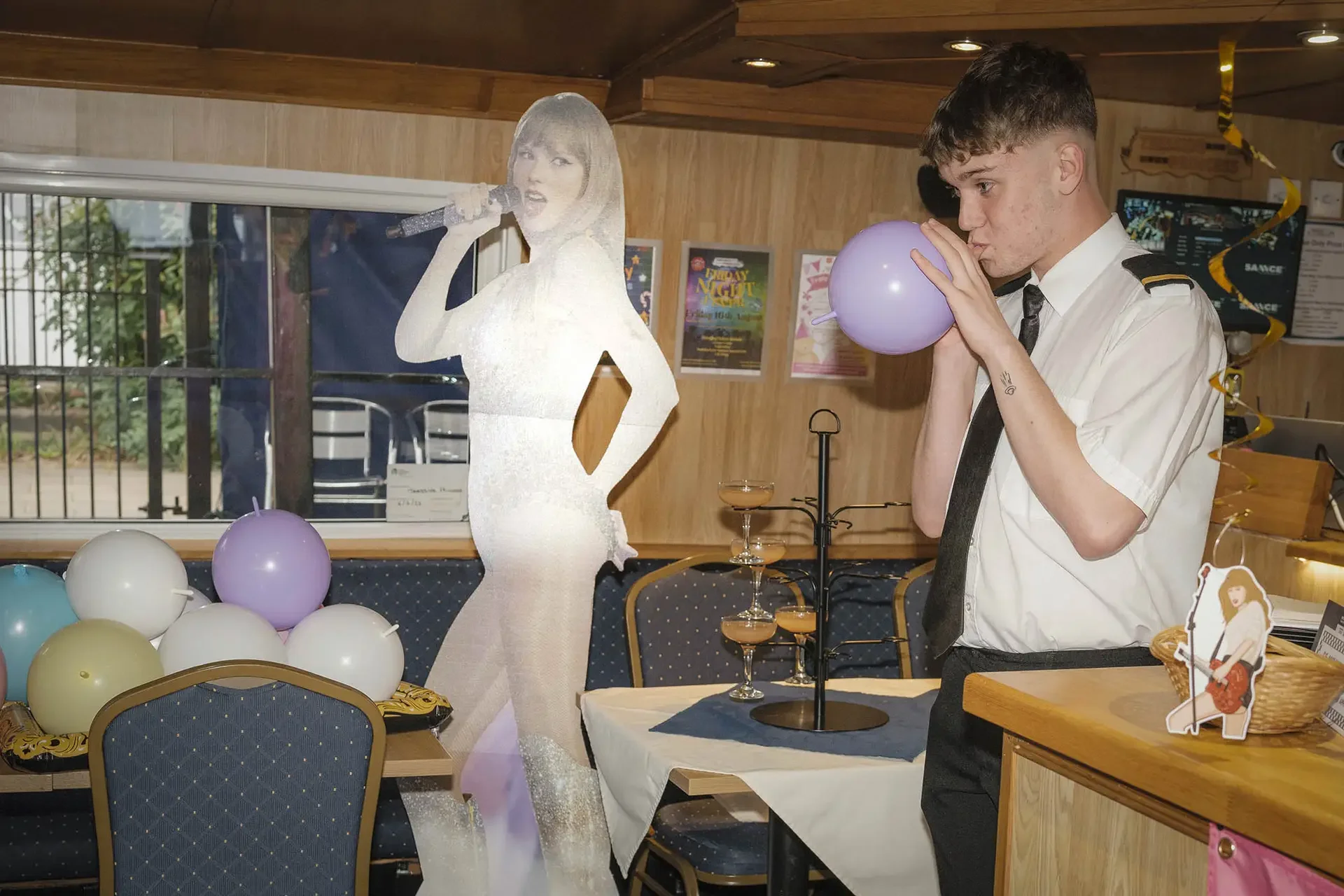
It was only when the life-size cardboard cutout of Taylor Swift toppled over, sending a tray of vodka shots rolling to the floor, that things really started to get messy.
Up until that point, the Swifties summer boat party – a three-hour sailing trip down the River Tees (adults only, dress-up encouraged) – had unfolded in an atmosphere of mild-mannered debauchery. Themed cocktails were drunk on the deck. Selfies were taken underneath the balloon arch. Contestants in a Taylor Swift quiz fought combatively, but generally without violence.
Now though, as the sun began to set upon the waterway and a laser light show burst into life within the gloriously ramshackle ‘Teesside Princess’, any last semblance of restraint seemed to disappear. One young woman in a Taylor Swift mask became entangled with her friend in a thicket of pink streamers hanging over a doorway, and brought it crashing down in a riot of giggles and hotpants. Another young woman in a Taylor Swift mask commandeered a microphone from the increasingly beleaguered DJ and launched an impromptu singalong to ‘Bad Blood’, which was rapidly taken up with gusto by the crowd. An unseen hand grabbed my pen and notebook, and sent both spinning wildly across the dancefloor. By the time I wrested them back, the words ‘Fuck Jake G!’ (a reference to Swift’s former boyfriend Jake Gyllenhaal) had been scrawled triumphantly on several pages.
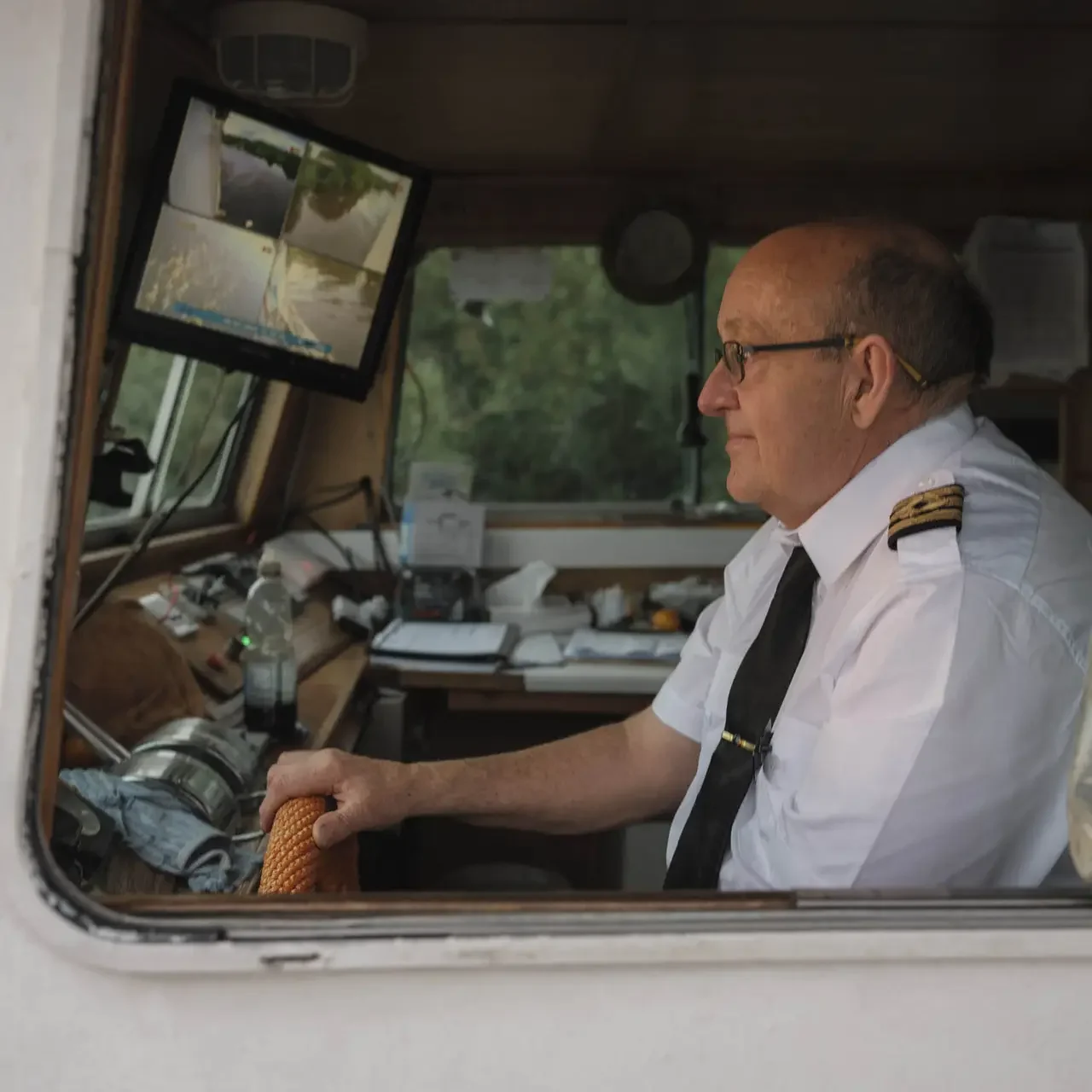
I stumbled my way through the chaos and managed to reach the helm, where 70-year-old skipper Colin Robinson was at the wheel and gazing stoically out at the darkening riverbank. The following evening he would be back here again, piloting the boat as it hosted a traditional roast dinner for a largely elderly clientele; the day after that, the decks would be heaving with small children enjoying afternoon tea while dressed as characters from the Disney film ‘Frozen’. On the Princess, a history-laden pleasure cruiser that has come to symbolise something vital and complicated in this troubled corner of post-industrial Britain, the whole of life is on display – and Robinson smiles indulgently through it all.
He navigated us gracefully around the tight bends of the Tees, which winds its way eastwards from the Pennines before emptying out into the North Sea. The surrounding air was silent, apart from the muffled beats of the party raging behind us, and Robinson’s slow roll-call of the huge manufacturing plants which once dominated the skyline in these parts – iron, steel, shipbuilding – and which have since been shuttered and razed and replaced with great expanses of open space. “It’s sad, there’s not much to hold people up now,” he said, before suddenly grabbing my arm and pointing me towards some ripples up ahead. Through the shimmering disco lights of the Princess, I could just make out a family of otters, diving noiselessly for fish amid the gloom.
***
Teesside is a proud, scraggly, mishmash of a place, stretching from the affluent market town of Yarm – all boutique shops and cobbled streets – out to the mammoth beach at Redcar, where rusty pipes and hulking chemical drums peek out from behind the dunes. The region’s biggest conurbation is Middlesbrough, but its geographical core lies a few miles to the west in the ancient port of Stockton, which once served as one of the major maritime hubs of the north-east. In common with the area surrounding it, Stockton – which technically straddles two English counties and six separate towns – can be hard to pin down; fierce debates over the community’s cultural and administrative identity play out regularly in the pages of the local newspaper. The main thing that really ties Teesside’s many loose threads together is the river that gives the region its name, and at the heart of that river – on a mooring spot in central Stockton, sandwiched between a curry house and a nail salon – lies the Teesside Princess, floating serenely above the confusion.
In a waterway brimming with gargantuan structures, from oil tankers and container ships to barrage dams and soaring bridges, it’s not easy for a modestly-sized pleasure craft to stand out from the crowd. But the Teesside Princess manages it, not so much for its appearance but because of the way in which it is subtly woven into the fabric of so many people’s lives here. The height of a house and the length of a swimming pool, the 100-capacity vessel began life at a boat-builders in nearby Hartlepool in the mid-1990s, before taking up residence at its current home: a landing stage directly opposite the site of Margaret Thatcher’s infamous ‘walk in the wilderness’, which had taken place a few years earlier. The event was an ill-judged photo-op that featured the Tory prime minister striding across the ruins of a once-bustling engineering works which had recently been mothballed, and was now being slowly reclaimed by rubble and weeds.
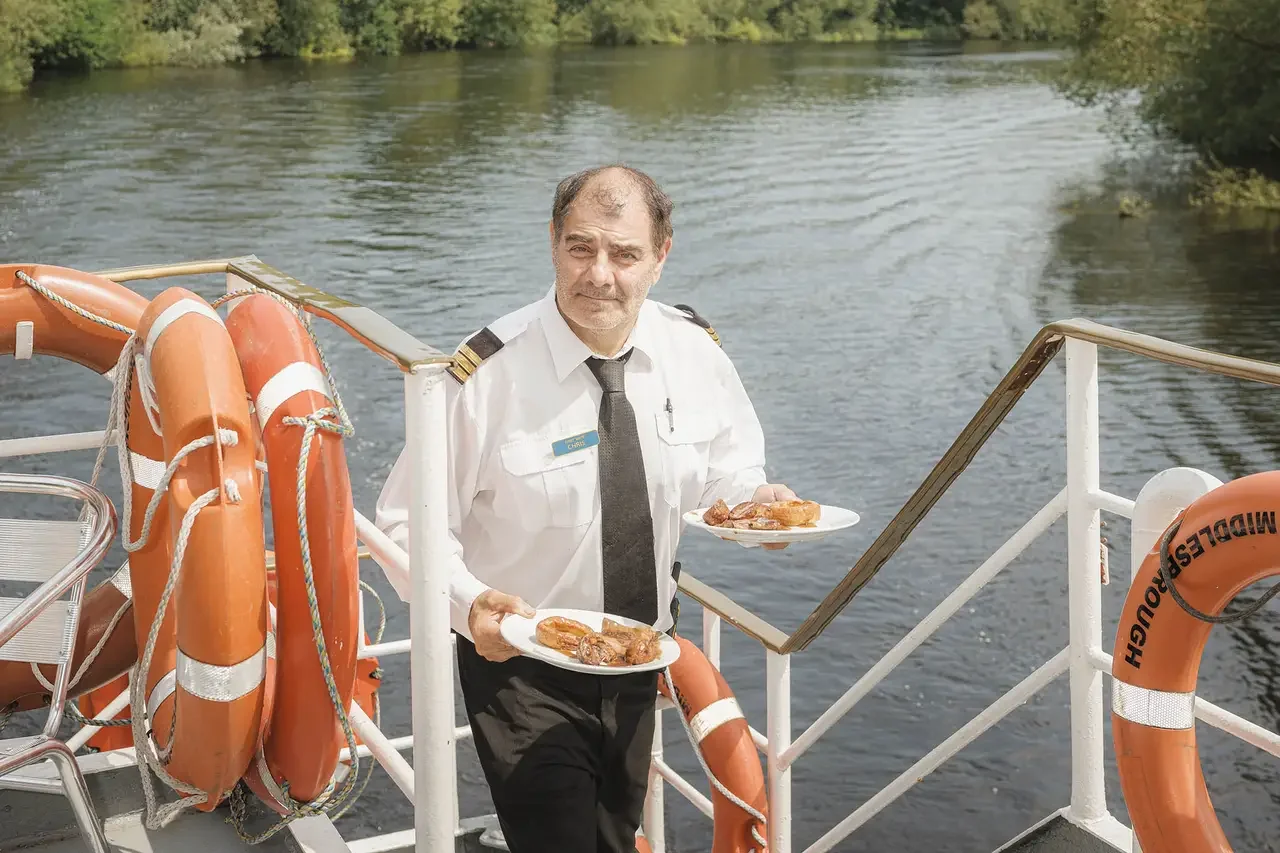
Intended to demonstrate that Thatcher understood the pain of working-class communities which had been devastated by the economic shocks of the 1980s, and that she was committed to regeneration through the spirit of private enterprise, many in Teesside interpreted the spectacle very differently: as their tormentor-in-chief coming to admire her destructive handiwork, clutching her designer handbag and dismissing her critics as ‘moaning minnies’ along the way. By the end of Thatcher’s premiership, almost a quarter of a million jobs on Teesside had been lost, changing the face of the Tees forever. It was into that maelstrom that the Teesside Princess launched. “Everything else has come and gone,” says Chris Hughes-Rutherford, who has worked on the vessel for nearly three decades and is the veteran of a thousand local school trips, raucous booze cruises, and musical tribute nights. “But we’re still here.”
That note of quiet defiance could often be detected whenever I talked to people about the Princess. “She’ll be tooting her horn long after the rest of us have gone,” one old-timer told me during an afternoon sailing, as he tucked into a meat and gravy lunch buffet with gleeful abandon. On another occasion, a passenger who had travelled by bus from Sunderland to enjoy a cruise swore that in the years to come both her daughter and her granddaughter would be doing the same. When I asked Nathan Hobday, owner of the Teesside Princess, about why it evoked such strong emotions, he paused for a moment before gesturing out at the river, as if the answer were obvious. “People here have gone through a lot: a lot of change, a lot of pain, a lot of promises,” he said, finally. “And the Princess… well, she’s a survivor.”
Hobday is only a few years older than the Princess. Just like his boat, he has spent most of his life on the water – providing him with a front-row seat on to the economic and social tumult that has played out here over multiple generations. In common with almost everyone I interviewed for this story, he is well-versed in Teesside’s rich mythology: the astonishing 19th century transformation of a largely rural backwater into an industrial powerhouse fuelled by iron ore mined from the Cleveland Hills; the rise and rise of Middlesbrough’s ‘Ironopolis’ in the Victorian era; the global landmarks – from Manhattan skyscrapers to Sydney Harbour Bridge – that were built on Teesside and remain standing today. “We were known as the ‘infant Hercules’,” he told me, referring to a nickname bestowed on the area by William Gladstone in the 1860s. “And we thought we always would be.”
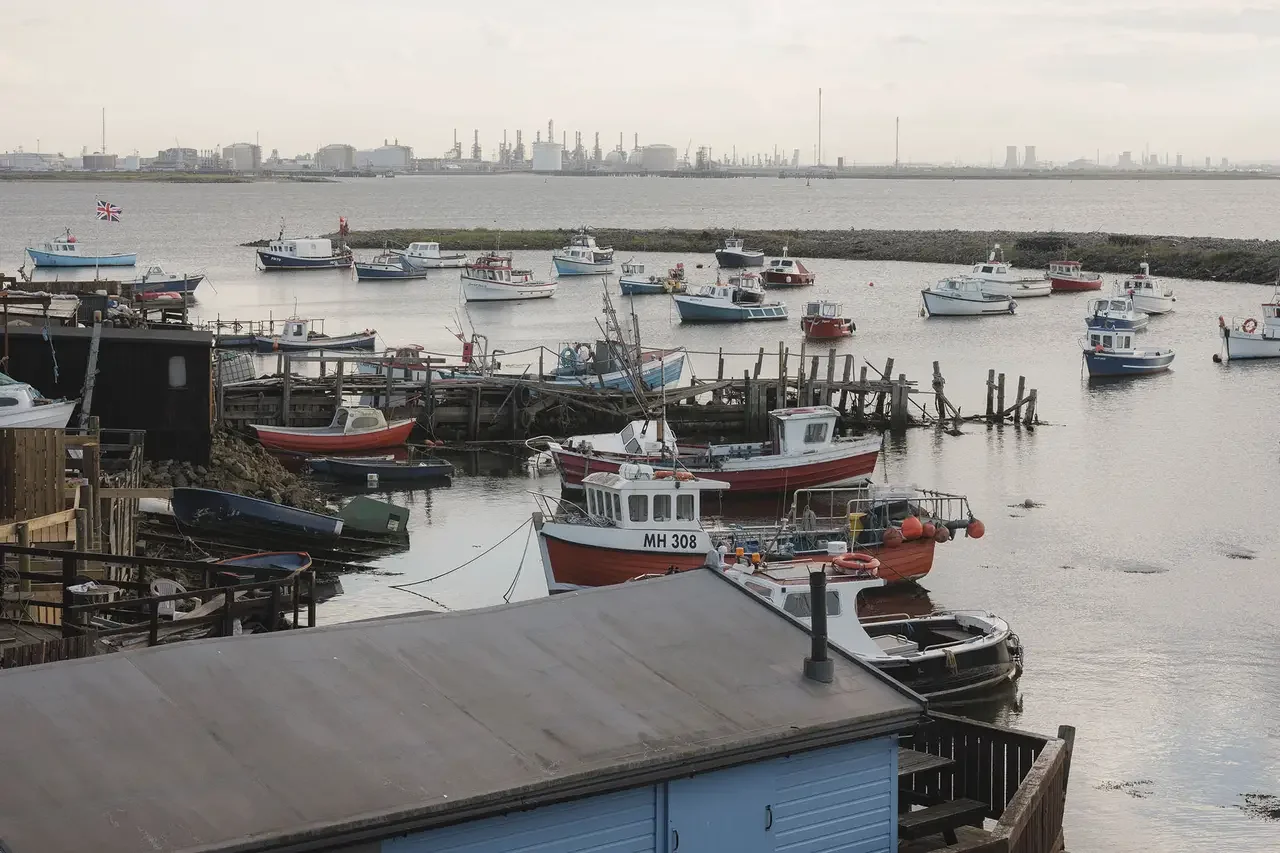
Part of the reason for that optimism lies in the way that Teesside has bounced back from adversity and reinvented itself, time and time again. In the early 20th century, the metalworks that loomed over the riverbank were joined by giant petrochemical plants, which underwent significant expansions during both world wars; ICI’s ammonia factory at Billingham, just a couple of miles downriver from the Princess, was one of the most important fertiliser production sites in the country, and the inspiration behind Aldous Huxley’s dystopian masterpiece ‘Brave New World’. Even after the turmoil of Thatcherism, the area clung on to its status as an industrial heartland – so much so that its inhabitants became colloquially known as ‘Smoggies’, due to the thick clouds of pollution that belched from Teesside’s chimneys throughout the day.
The majority of those chimneys were associated with the substance that came to define Teesside’s character: steel. At the industry’s height, no less than 91 different blast furnaces stood within a ten-mile radius of the river’s eastern reaches, and plaques bearing the name of the area’s biggest employer – Dorman Long, which was eventually nationalised and absorbed into British Steel – could be found on bridges and towers as far afield as Denmark, China and the River Nile. Inside the steelworks, life was hot and often dangerous; labourers could get burned by molten metal, crushed by heavy machinery, or choke on toxic fumes. But the jobs were plentiful and largely unionised, offering a reliable route to financial security for generations of ordinary families, as well as an entire social ecosystem – pubs, clubs, dances and sports teams – that provided many Teessiders with a collective identity and a sense of their place in the world.
“From the sea, you would use the glow of the steelworks to orientate yourself and find your way back home,” said Hobday. “When the last furnace came down, it was like someone flicked a switch. Suddenly the whole landscape was this big, black abyss.”
Hobday was born and raised in Redcar, a place so thoroughly interwoven with the life of the steelworks that one of its main neighbourhoods is named Dormanstown, after Dorman Long. He spent his childhood cycling out along the nearby breakwater to South Gare, home to a lighthouse that marks the end of the Tees and the start of sea, as well as great shoals of mackerel that attract hardy fishermen and hungry seals. It’s a wild spot, where humans are dwarfed by humongous freighters, and arachnid-like industrial exoskeletons claw at the slate-grey sky. “I feel fortunate to have grown up there on the seafront,” Hobday told me. “The water, the river, the boats both big and small: it all felt like a natural part of the landscape to me.” Some of his fondest memories involve being taken by his aunt and uncle for rides on the Teesside Princess, where he would always pester the captain for a chance to blow the horn.
By the time he left school at 17, Hobday was itching to start manning vessels of his own. His first role was as a lifeboat volunteer; he worked his way up the river’s labour ecosystem, becoming a general deckhand on the pilot boats that guided the biggest ships into port. It was the early 2010s, and on the face of it the smokestack edgelands of the Tees were booming. Out on the pilot boats though, Hobday and his colleagues saw a different story. “We were the first to suspect that something was wrong, because jobs kept getting cancelled due to the steelworks struggling to pay its bills.” Their suspicions proved correct. Cheaper Chinese steel imports had started flooding the global market, and with the British government unwilling to provide the kind of state subsidies that the steel industry depended upon in other western nations such as Germany and Italy, a bitter struggle ensued between trade unions and the plant’s Thai owners, Sahaviriya Steel Industries. In 2015, the last remaining blast furnace at Redcar was switched off for good. The structure had taken five years to build and dominated the Tees horizon for nearly half a century, producing more than 10,000 tonnes of iron a day at its peak. 175kg of explosives were eventually used to bring it down. Upon ignition, the whole thing collapsed in seconds.
From the deck of the Teesside Princess that day, where preparations were underway for the boat’s annual run of Christmas-themed Santa cruises, the demolition registered as little more than an eerie, deadened boom. But the end of 150 years of Teesside steelmaking reverberated along the length of the river in deeper and more enduring ways. Some of them can be counted in official statistics: thousands more job losses; a huge surge in benefit claims, house repossessions, and mental health concerns; rising rates of child poverty, afflicting up to 85% of the population in the worst-affected council wards. Others are more intangible. In Redcar itself, which remains one of the most deprived towns in the country, retailers on the high street closed up one by one. In an effort to ward off the visual blight of empty shops, the local authority installed ‘virtual shops’ in their place – photographic simulations of furniture outlets, bookstores and buzzing cafes that were plastered over security shutters, masking the hollows beyond. “There was no one in Redcar who didn’t have a family member, or know someone with a family member, in the steel works,” remembers Hobday. “And then one day it wasn’t there, and we were losing our identity. Everything around us felt a little bit fake.”
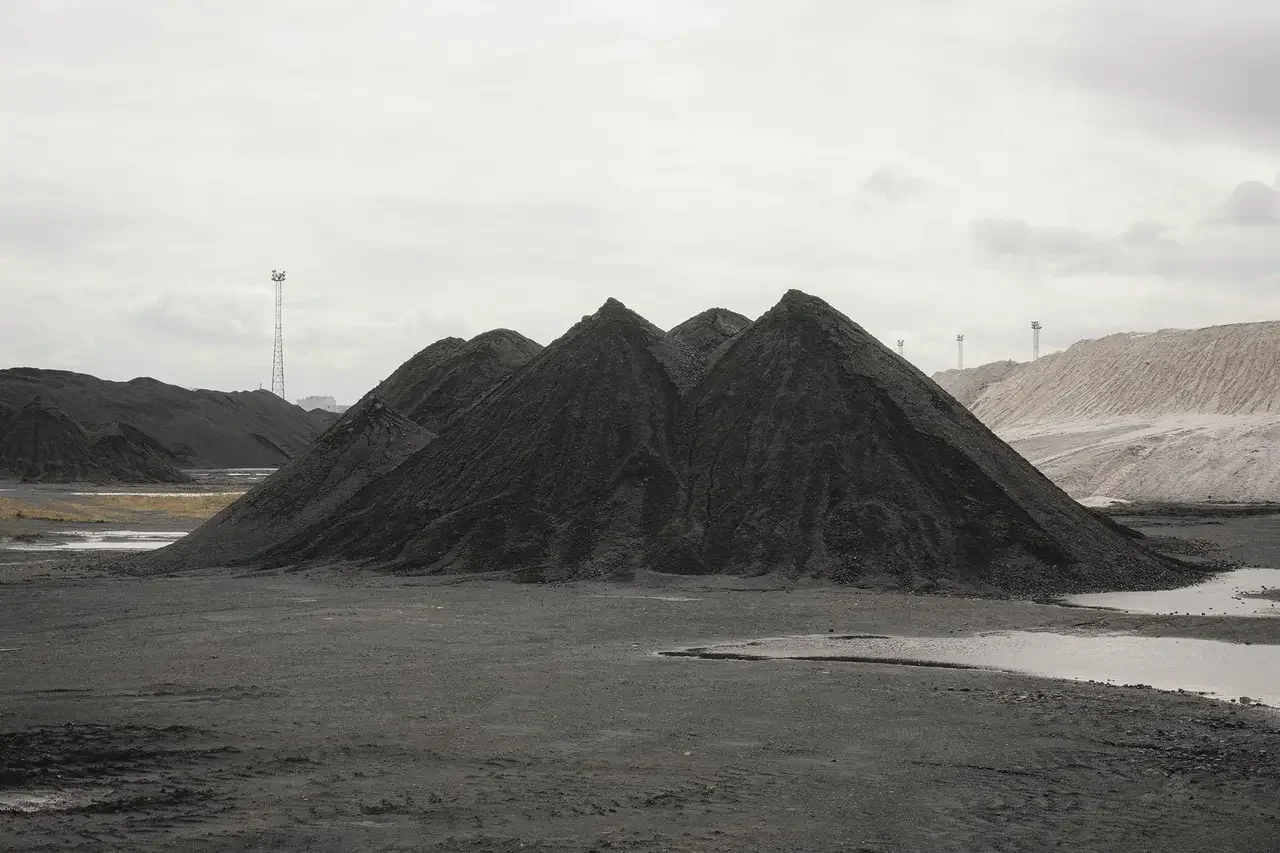
Shards of the past are still scattered all over Teesside, adding to that sense of unreality. There are slag heaps, some as black as jet and others crusty white, creating a fantastical moonscape on the riverside. There are old railway stations that once served the steelworks, now home to rugged wildflowers pushing up through cracks on platforms that haven’t seen a train for years. There is a museum at Kirkleatham in which you can view the preserved contents of a steelworker’s locker through a glass panel (Brut deodorant, safety helmets, and a ‘Hits 2000’ compilation CD), and admire souvenir programmes from the annual Teesside steel family gala held at Redcar Racecourse, all framed neatly on the wall. And, of course, there are the working men’s clubs – dozens of them – which once formed the backbone of social life along the Tees, and in some cases have survived to this day.
At Dormans Club in Middlesbrough, founded in 1899, photos of the steel plant still line the corridors and a weekly country and western night draws many former steelworkers to the dancefloor. “Steel here meant life,” said Alan Metcalfe – an 84-year-old stock-taker at Lackenby, one of the many British Steel sites in the area. He was the third-generation of his family to work inside the plant, and had come to Dormans with his wife Nita. They met at the Astoria club after a 1963 Beatles concert which she was attending at the Stockton Globe theatre, a few blocks north of the Teesside Princess moorings, was interrupted by the announcement of President John F Kennedy’s assassination, forcing her to search out entertainment elsewhere. “It wasn’t just the jobs, it was a mentality: we all stood together and supported each other,” she reflected. “But everything’s flat now.”
Clinging on to and refashioning bits of what came before – the things that gummed people together, and put them on a map – is a task that many in Teesside are now engaged in. Steel “gets into your soul”, the manager of the Redcar blast furnace once told journalists; in the absence of steel, other distinct markers of Teesside’s identity have had to step up and fill the void. Peg Powler is a green-haired, folkloric water spirit long said to inhabit the murkier stretches of the Tees, from where she would pluck inquisitive children on the riverbank down into the depths, and lure sailors to their death by pretending to be a beguiling woman drowning. She’s now been granted a new lease of life as a key character in the novel ‘Ironopolis’ by Glen James Brown, which explores how memories and place get tangled up against the backdrop of economic decline. “Beauty and decay do not exist independently from each other,” notes the book’s narrator. “Peg collapsed all that.” More prosaically, the legendary Teesside ‘parmo’ – a local artery-shredding delicacy consisting of a breaded chicken cutlet slathered in cheese and bechamel sauce, supposedly created by a Greek-American navy chef who wound up in Middlesbrough after being hospitalised during the Second World War – is growing in popularity. Asda now stocks its own version, and a specialist parmo takeaway outlet is trying its luck as far afield as London.
By virtue of its persistence, as much as anything else, the Princess – which stages birthday celebrations, graduation parties, weddings and wakes – has likewise become entwined with Teesside’s soul: a home for life’s big milestones and its whimsical moments, a floating avatar for a community that doesn’t have a lot left to call its own. “We’ve had our dramas,” admits Hughes-Rutherford, the first mate, who – although he’s never encountered Peg Powler – went on to tell me about the time the vessel almost got stuck in the lock at the Tees Barrage; the time a mechanical problem necessitated a (sedate) rescue of all the passengers near Preston Park; the time a hen party for which all the guests were dressed up as grandmas spiralled out of hand. “But they’ve toughened us up.” His least favourite place on the boat is the compartment in the engine room where the wastewater tank is kept, which someone is occasionally required to frequent in order to adjust the pump. His favourite spot is in the DJ booth on the lower deck, microphone in hand, running through the highlights of the beautiful, knotty river that he loves.
With evident pride, he reeled off for me every occasion that the Princess has appeared on television, the most recent being an episode of the Teesside-based BBC drag comedy, ‘Smoggie Queens’. “All my kids have worked on the Princess at one time or another,” he said. “The lad serving drinks today is my grandson.” From some angles, with its wooden veneer panels and starched tablecloths, the Princess can look like an anachronism. From others, it looks more like a resurrection – of feelings, hopes and principles that will not fade away.
***
For most of the post-steel era on Teesside, the Princess was under the ownership of local businessman Ian Edge. He narrowly won the boat in an auction by outbidding investors who planned to remove it from the area altogether and establish it as a floating residential property in southern England. As the region began its reckoning with the loss of the Redcar blast furnace, Edge smartly pivoted away from the Princess’s booze-soaked reputation and began marketing it as a cultural icon for the area, providing a way for young people to connect to the river and offering free hire to nearby charities. By the time he died last summer in a tragic skiing accident in the French Alps, the Tees was undergoing its latest metamorphosis. “Nothing stays still for long,” said Nathan Hobday, who had now built up his own marine services operation at the industrial end of the river, and bought the Princess from Edge’s widow. “It’s a bit like being out at sea: when things go wrong, you have no option but to get on with it and find a workaround. You can sit in the wheelhouse and scream and swear until you’re blue in the face, but this is your reality now. You have to move forward.”
Today, Teesside is certainly on the move – though in what direction, and in whose interests, remains to be seen. In Stockton, the Labour-led local authority is overseeing one of the most ambitious regeneration projects in Europe: buying up great swathes of retail space in the struggling town centre, only to knock it down and replace it with vast new public domains. The assumption is that as we increasingly shop online rather than at bricks-and-mortar stores, other types of institutions will be needed to provide communities with a sense of physical coherence and shared identity. If all goes to plan, Stockton’s will include a new waterfront park three times larger than Trafalgar Square, with an amphitheatre that gazes down directly upon the Princess’s landing stage. “I don’t want this town to die on my watch,” Nigel Cooke, the councillor chiefly responsible for driving through the changes, told me. “I don’t want that to be my legacy.”
Downriver, east of the Princess, cranes and trucks are also buzzing relentlessly around the site of the old steelworks – now home to the Teesworks ‘freeport’, a special low-tax investment zone championed by the Conservative Tees Valley mayor, Ben Houchen, which has been mired in corruption allegations for years (Houchen, who declined to be interviewed for this story, denies any wrongdoing; an independent review published in 2024 found no evidence of illegality, but criticised a lack of transparency among the project’s leaders). The vision here is of a new clean, green industrial hub that will bring jobs pouring back into the area via the private sector – featuring a biomass energy plant, a factory specialising in wind turbine production, and a vast carbon capture operation backed by billions of pounds worth of central government funding. “This is the politics of national renewal in action,” prime minister Keir Starmer claimed, when announcing the carbon capture plans. “Today, a new era begins.”
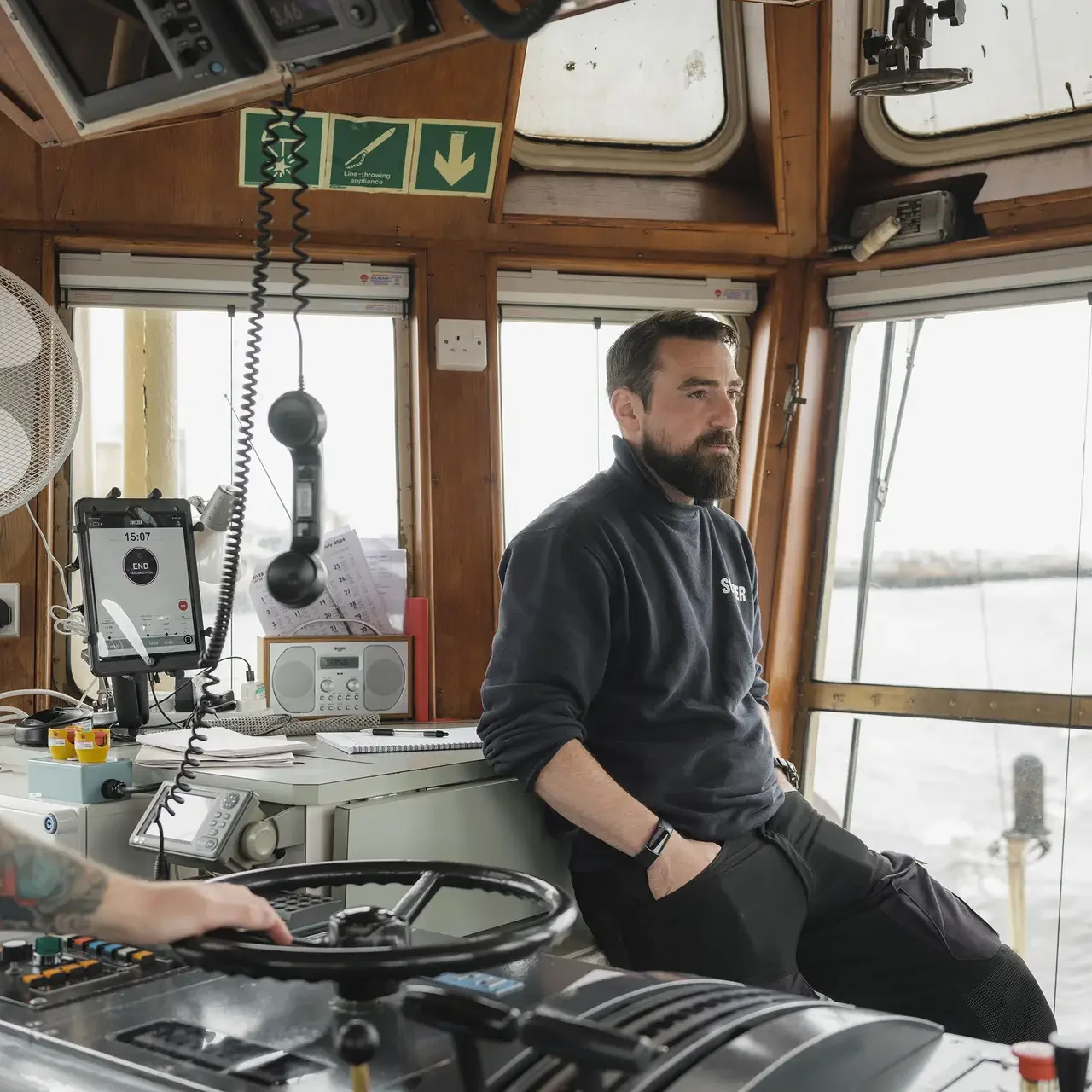
Among businesspeople with connections to Teesworks, there is now genuine optimism about where the region is heading. “Teesside is the most exciting area of our UK operations,” insists Michael Paterson, the UK managing director of Svitzer, a global maritime towage operator. He added that, on current trends, it won’t be too long before cargo levels on the Tees surpass their Victorian-era peak. But out on the river’s tugboats, among the froth, slosh and grime of the waterway, workers tell a more nuanced story. “There’s lots of activity, it’s true, but the economy has changed now,” one explained to me, as we bucked through the waves around South Gare. “That old-school, proper capitalism – you know, where the message was ‘if you work hard, you’ll get on, and be able to afford a house and a mortgage and a family and all that’ – it’s just not there anymore.” It was a refrain I heard time and again on Teesside: in pubs, clubs, high streets, and on the decks of the Princess. New opportunities are arising, but the kind of holistic security that the steel industry once promised – both economic and psychological – seemingly remains out of reach. “From land, you can’t really spot anything behind the Teesworks building site hoardings, other than emptiness” said another crew member on the tugboat. “At the moment, we’re struggling to see the future.”
As it has been throughout its modern history, from Gladstone to Thatcher to Starmer, the river Tees is now a canvas for grand political visions projected from afar. Other post-industrial communities are watching closely, to see whether this restless, contested slither of the world – the one that the Teesside Princess has traversed for so many years – can turn the corner, and provide some collective hope at a time when collective hope has clearly been in short supply. The problem is that big regeneration projects take time, and demand an act of faith on the part of those supposedly set to benefit in the long-run. And the region’s political and economic leaders, in common with most of Britain’s political and economic leaders, command little faith at the moment. From the 2008 financial crash to the contemporary cost-of-living crisis, few people trust those in power to make decisions for the common good, and cynicism is rife.
“It’s been a boiling kettle for a while now,” said Hobday. “Pretty much everyone around here has worked their bollocks off at some point, grafting at a shit job to earn some kind of crust, and they feel like they’re getting screwed over – like the rewards aren’t what was promised. People think they deserve more.” On a Sunday afternoon in August last year, the kettle began to boil over. A rally in Middlesbrough, ostensibly to honour the victims of a knife attack in Southport, descended rapidly into street violence: some protestors clashed with police, set fire to cars, and – in horrific images that travelled around the world – constructed makeshift checkpoints in order to check the ethnicity of passing motorists. A community that was built upon waves of international migration, particularly from Ireland and Italy, and which dispatched volunteers to fight fascism during the Spanish Civil War, was now playing host to a far-right riot. Hobday was forced to send staff down to man the Teesside Princess, for fear she would be targeted in the disorder.
For Kirsty Galloway, a senior youth worker in Middlesbrough who helps run children’s services in some of the poorest parts of the town – including the neighbourhood of Whinney Banks, which lies just over the river from the Princess, on the other side of a huge retail park – the events of last summer were a personal heartbreak. “There’s frustration, and nihilism among many of the young people,” she told me. “Their dads were told that they could get an apprenticeship at the steelworks and they’d be set for life; these kids don’t have that. What they do have is access to social media where simple but incorrect explanations for poverty – blame the immigrants, etc. – quickly find an audience, and people are desensitised to violence.” Galloway’s charges are racially diverse and generally get on well inside the youth centres, but some of them ended up actively fighting each other during the unrest.
“It’s big, long-term, structural failures that help explain why these children’s lives are hard,” said Galloway. “Is there going to be a realistic path for them to go and work in all the new industry that’s supposedly coming up on the Tees? I don’t know, is the honest answer. And I’m not sure they really believe that path is there either.” I spent time at two of Galloway’s youth clubs, asking attendees what they were hoping to do once they left school. Several mentioned becoming social media influencers or stars on TikTok; others are already involved in drop-shipping (the sale of products online which are then sent to customers directly by the manufacturer, enabling the middleman to skim off a profit) and intend to pursue it full-time as adults. “A lot of people just want to run away and make their fortune,” one teenager told me. I asked her where to, and she shrugged. “Anywhere but here.”

For Hobday – who really does believe that Teesside’s future is bright – part of the Princess’s raison d'être is to change the relationship that teenager has with the thorny, intricate concept of ‘here’. “People ask me why I’m doing this, and the answer is that I don’t really know,” he said. “It doesn’t involve prestige. And it’s not about the money.” We were sitting outside at the back of the boat, with the elegant arches of Stockton’s Infinity Bridge reflected in the water behind us. “I guess, like many others, I feel obligated to find a succession plan for this river – because without it I wouldn’t be who I am today. It gives me a reason to get up in the morning. And I don’t know how exactly, but the Princess seems to be a part of that.”